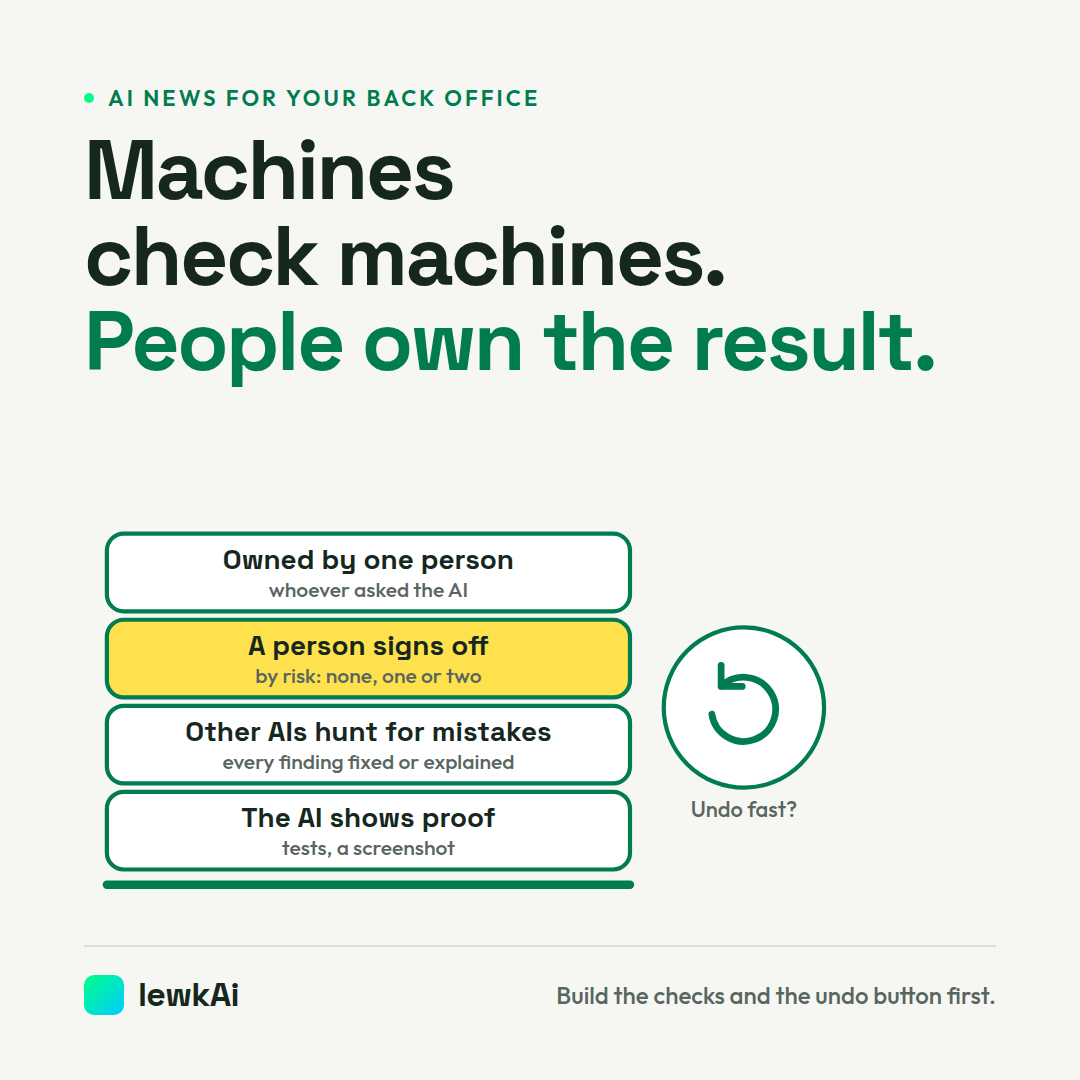
Check AI's work with layers: make the AI show proof, let other checks look for mistakes, and keep a person signing off where the risk is high. And only let AI do more once you can undo its work fast.
Anthropic's own team no longer reads every line of code its AI writes.
They can't. Claude now writes most of Claude Code. Anthropic says its main code base went from about 2,500 to more than 30,000 changes a day. (Their numbers, not mine.)
So they changed the question.
Not “did a person read it?”
But “which check, machine or human, is the right one to catch what could go wrong?”
Their answer is layers:
- The AI must prove its work: run the tests, show a screenshot. “Done” is not proof.
- Other AIs hunt for bugs. Every finding gets fixed, or closed with a reason.
- People approve by risk. Small change: nobody. Normal: one person. Risky: two.
- Anything can be switched off and rolled back fast.
Two rules I like most:
- An AI's approval never counts as a person's.
- Whoever asked the AI to do the work owns the result.
None of this is new. Double-entry bookkeeping has done it for 500 years: the books check themselves, and a person designs the checks.
lewkAi is a small company, and I've just copied a small version:
- an AI review before every code change I merge
- my agents must show proof, not just say “done”
- after 3 rounds of review, stop and rethink the approach
- a “never again” list of past mistakes that every review checks
Machines check machines. People own the result.
So if you're about to let AI touch your invoices, bookings or customer messages, build two things first: the checks, and the undo button. Then decide which decisions still need a person.
If someone at your place is rolling out AI this month, send them this first.
Which decision in your business should always need a human to sign it off?
Five questions to ask before AI touches a process
- What could go wrong?
- Which check catches it: a rule, another AI, or a person?
- Who signs off, and how many people for the risky cases?
- How fast can we undo it?
- Who owns the result?
Source: Anthropic, “How the Claude Code team does code review” (15 October 2026). The figures are Anthropic's own. Hat tip: David Shapiro's video on it.