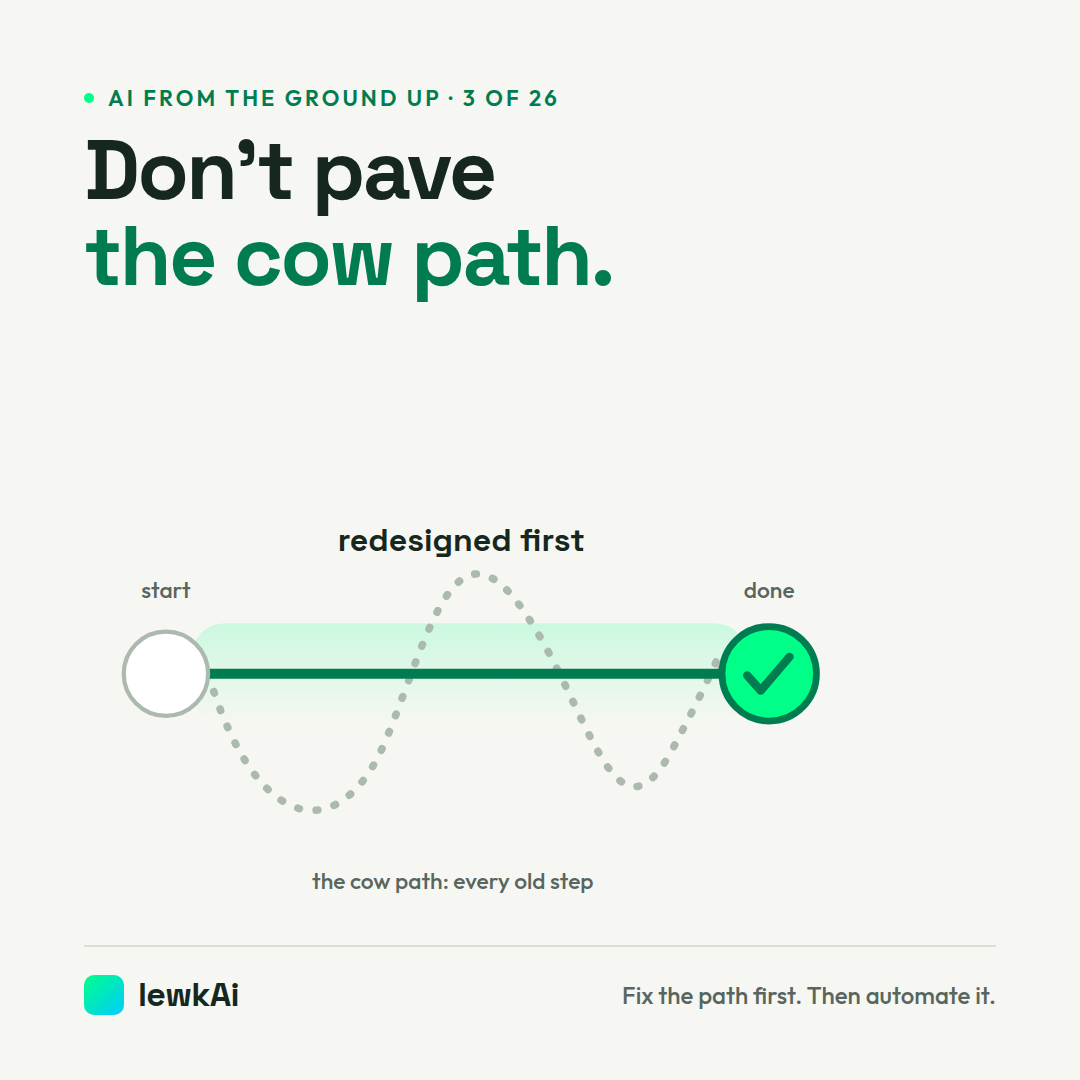
Many AI pilots fail because they put AI on top of the old process, mess and all, so the work gets faster without getting better. Before you automate, ask why each step exists, drop the steps nobody needs, and only then hand the repetitive ones to AI.
Cows don't plan their routes. They wander, and over the years the wandering becomes a path. Pave it, and you get a very smooth wander.
Most business processes grew the same way.
A step added after one bad month.
A spreadsheet because the system couldn't do something years ago.
An approval nobody remembers asking for.
In 1990, Michael Hammer wrote in Harvard Business Review: “It is time to stop paving the cow paths.”
His example was Ford. It planned to computerise its accounts payable department of more than 500 people and expected about 20% fewer staff. Then it saw that Mazda ran accounts payable with five people. So Ford redesigned the whole process instead, and got a 75% reduction.
Ford took that gain as job cuts. That's not the part to copy. We redesign so people get their time back for the work that needs them.
The lesson holds for AI. Put AI on top of a messy process and you get the same mess, faster. Then the AI gets the blame for a process nobody questioned. That's a big reason AI pilots disappoint.
So before you automate a step, ask:
- Why does this step exist?
- What happens if we stop doing it?
- If we started from zero today, would we build it this way?
Then hand the repetitive work to AI, so your team can focus on what moves the business.
Which step in your business only exists because “we've always done it that way”?
Source: Michael Hammer, Reengineering Work: Don't Automate, Obliterate, Harvard Business Review, July-August 1990: “It is time to stop paving the cow paths.” The Ford and Mazda accounts payable figures are from the same article; Ford's 75% was a cut in head count. “A big reason AI pilots disappoint” is lewkAi's framing, not a measured rate.