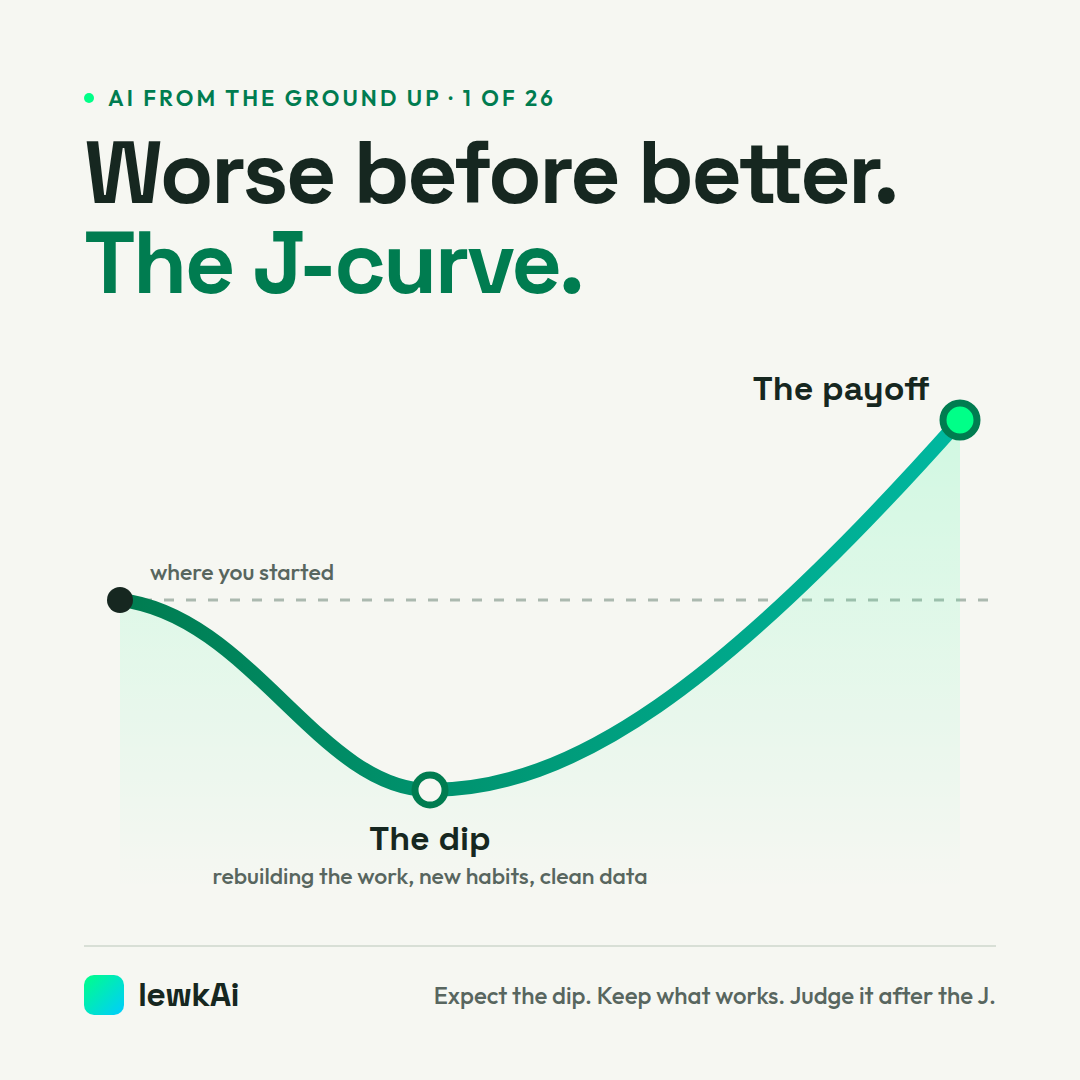
You've probably heard about the S-curve: change looks slow, until it isn't. There's a second curve nobody warns you about. It's shaped like a J.
When a business brings in a big new technology, things often get worse before they get better. Economists saw it with electricity and with computers. In 2025, a study of US factories using Census data found the same with AI: losses first, gains later.
Why the dip?
Because the tool is the easy part. The hard work is everything around it:
- rebuilding how the work runs
- helping people learn new habits
- cleaning up the data
None of that shows up as output at first. It just looks like cost.
The study found one more thing.
About a third of the losses came from firms dropping the good management habits they already had, in the rush to change. Older firms were hit hardest.
So, three things before you start:
- Expect the dip, and plan for it.
- Keep the routines that already work while you change the rest.
- Judge it after the J, not in the middle of the dip.
Over the next 26 weeks we'll walk through how to bring AI into a business from the ground up. One step a week, in plain words.
Where is your business right now: before the dip, in it, or coming out of it?
Source: McElheran, Yang, Kroff and Brynjolfsson, “The Rise of Industrial AI in America: Microfoundations of the Productivity J-curve(s)”, US Census Bureau CES Working Paper 25-27, 2025. The study puts the “about a third” at older establishments that abandoned structured production-management practices.