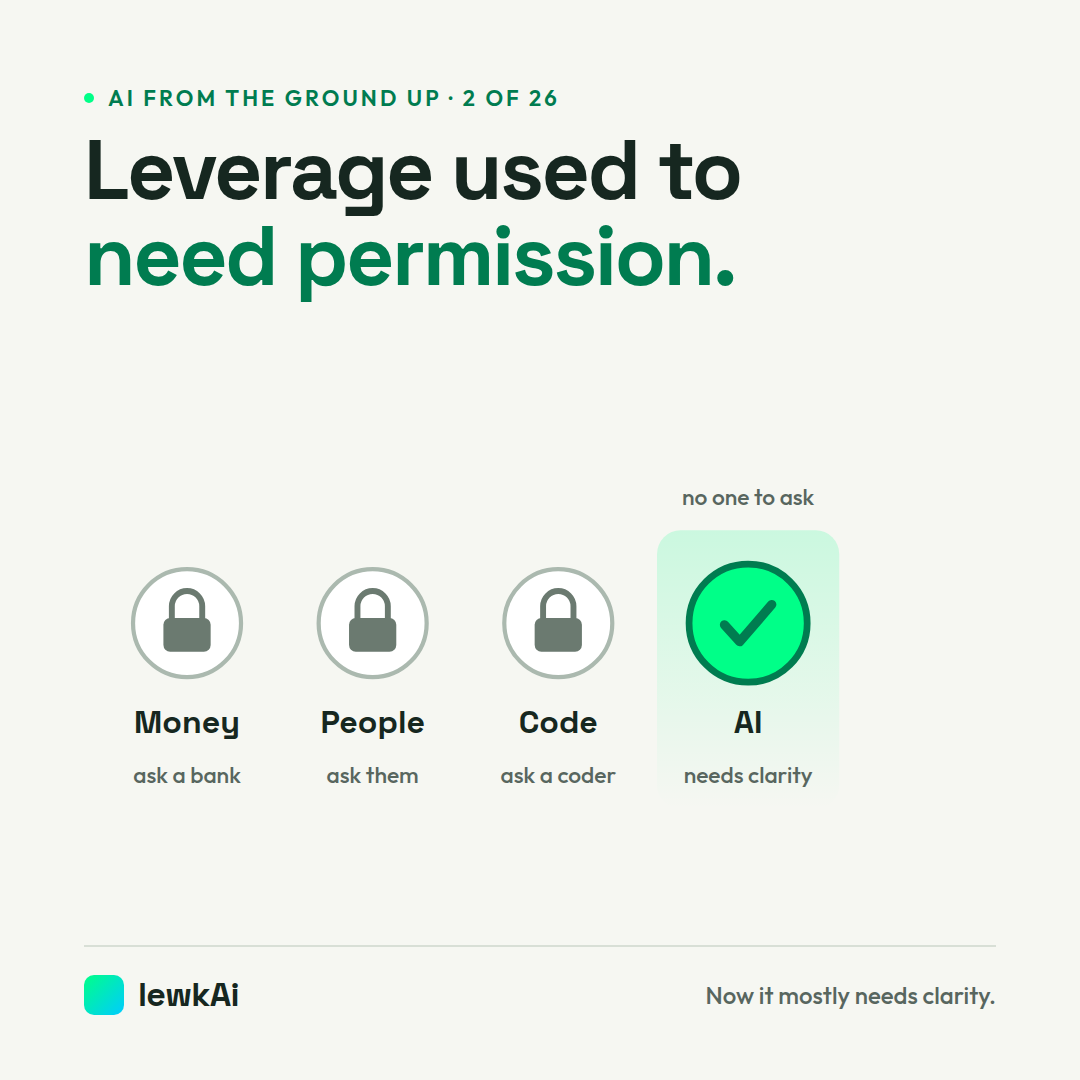
Choose a first process that happens often, follows rules you could write down, is easy to check when it's wrong, and that someone in your team can explain step by step. Leverage used to need a bank, new hires or a developer budget; AI has made routine thinking work cheap, so the scarce part now is picking that first process well.
For most of business history, doing more than your own two hands allowed meant someone had to say yes.
A bank had to lend you the money.
People had to agree to come and work for you.
Investor Naval Ravikant calls these “permissioned” leverage.
Software was the exception: build it once, run it a thousand times. But building it took developers, and developers took budget. Permission again.
That's the part that's changing.
AI makes routine thinking work cheap. Stanford's 2025 AI Index found that the cost of running a model at GPT-3.5's level fell more than 280-fold in about two years.
When the work itself gets cheap, the scarce thing is knowing what to hand over.
So the question isn't “which AI tool?”
It's “which process first?”
A good first process:
- happens every week, or every day
- follows rules you could write down
- is easy to check when it's wrong
- has someone who knows it well enough to explain it
Start there. Write down how it really runs, hand the routine steps to AI, and keep the judgment with your people.
Leverage used to need permission. Now it mostly needs clarity.
Hand the repetitive work to AI, so your team can focus on what moves the business.
Which process in your business would you hand over first?
Source: Stanford HAI, The 2025 AI Index Report: “the inference cost for a system performing at the level of GPT-3.5 dropped over 280-fold” (late 2022 to late 2024; fixed capability, not frontier models). The leverage idea: Naval Ravikant, “How to Get Rich (without getting lucky)”. “AI makes routine thinking work cheap” is lewkAi's framing, not Naval's.